How to Meet Tough Deadlines in New Product Development

Introduction
Deadlines in product development are often tighter than ever. A recent study found that over 40% of new products miss launch timelines, costing companies lost revenue, delayed market entry, and damaged customer trust. The real question many teams face is: how do you deliver innovation on time without compromising quality?
This guide breaks down practical strategies to meet tough deadlines in product development, from idea to launch. You’ll learn what product development really means, why deadlines are so challenging, and proven methods to speed up delivery while reducing risk. By the end, you’ll have a clear roadmap to handle demanding schedules and still create high-quality products.
What Is Product Development?
Product development is the complete journey of turning an idea into a market-ready solution. It involves:
Conceptualization — Brainstorming and validating ideas.
Design — Creating prototypes and product architecture.
Testing — Ensuring safety, usability, and compliance.
Manufacturing — Scaling from prototypes to full production.
Launch — Bringing the product to customers.
In today’s competitive environment, development cycles are shorter. Teams need to innovate faster while still meeting customer demands and industry regulations.
How Does Product Development Work Under Tight Deadlines?
When deadlines are short, traditional product development methods need to adapt. Here’s a step-by-step approach:
1. Start with Clear Requirements
Ambiguity wastes time. Align all stakeholders early with clear goals, success metrics, and timelines.
2. Adopt Agile or Hybrid Models
Break projects into sprints instead of one long cycle. This makes it easier to spot bottlenecks and adjust quickly.
3. Rapid Prototyping
Use 3D printing, simulation tools, and digital twins to validate designs faster without waiting for full production.
4. Parallel Workflows
Instead of sequential steps, run design, compliance, and testing tasks in parallel where possible.
5. Automate Where You Can
Automation in testing, simulations, and documentation reduces human error and saves weeks of work.
Key Components That Affect Deadlines
Certain factors directly influence whether deadlines are met:
Cross-functional collaboration — Engineers, designers, and marketers must work together seamlessly.
Technology stack — Using outdated tools slows down workflows.
Regulatory compliance — Missing certifications (e.g., FDA, CE) can derail launches.
Supply chain reliability — Component shortages often delay manufacturing.
Project management discipline — Clear milestones keep everyone accountable.
Real-Life Applications
Meeting tight product development deadlines matters across industries:
MedTech — Wearable devices for remote patient monitoring need to launch quickly to meet healthcare demands.
Aerospace & Defense — Rapid prototyping enables mission-critical equipment to reach testing phases faster.
Consumer Electronics — Short cycles ensure brands stay ahead of competitors with seasonal launches.
Automotive & EVs — Faster product rollouts are key to staying competitive in electrification.
Benefits and Challenges
Benefits of Meeting Deadlines
Faster market entry → competitive advantage.
Stronger customer trust → reliability builds brand reputation.
Lower project costs → avoiding delays means fewer budget overruns.
Higher innovation rate → teams can focus on the next product sooner.
Challenges of Tight Deadlines
Increased risk of errors if testing is rushed.
Higher team stress leading to burnout.
Possible compromise on product quality.
Supply chain bottlenecks outside your control.
Strategies to Meet Tough Deadlines in Product Development
Here are actionable tactics your team can use:
- Prioritize Features (MVP Approach)
Focus on the must-have features first.
Launch a Minimum Viable Product (MVP) and add improvements later.
- Leverage Digital Tools
Use project management software (Jira, Trello, Asana).
Apply AI-powered tools for design validation and testing.
- Strong Communication Cadence
Daily stand-ups or weekly syncs keep everyone aligned.
Transparent reporting helps prevent surprises.
- Risk Management Early
Identify risks (supply delays, compliance hurdles) upfront.
Build buffer time into the schedule for high-risk areas.
- Work with Trusted Manufacturing Partners
Choose suppliers with proven track records.
Ensure they can handle scaling production quickly.
- Document Everything
- A structured documentation process reduces confusion and ensures compliance.
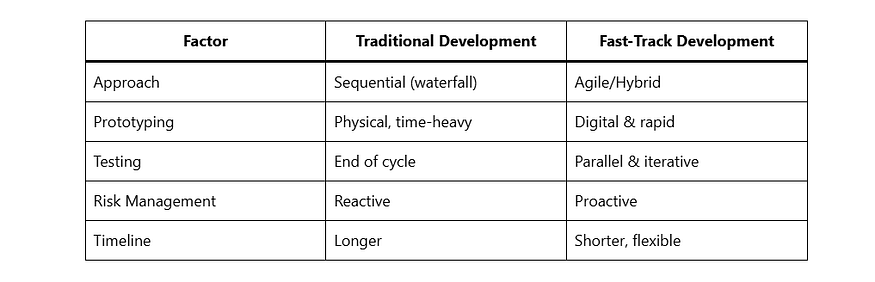
Table: Quick Comparison — Traditional vs Fast-Track Development
Press enter or click to view image in full size
Conclusion
Meeting tough deadlines in product development is not about cutting corners — it’s about working smarter, not harder. By setting clear goals, using agile workflows, prioritizing critical features, and leveraging digital tools, businesses can bring products to market faster without sacrificing quality.
The companies that succeed are those that adapt quickly, collaborate effectively, and embrace technology. With the right approach, even the toughest deadlines become achievable mile